


Parish of Sant’Erasmo: A Treasure of Faith and History in Formia
Via degli Olivetani, 23 – Formia (LT)
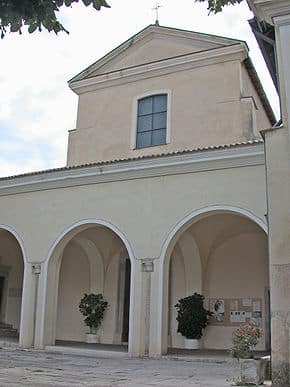
The Sacred and Fascinating History of the Parish of Sant’Erasmo
Nestled in the quiet of Via degli Olivetani in Formia, the Parish of Sant’Erasmo holds a thousand-year history steeped in faith, legends, and art. This sacred place, far more than just a church, represents a spiritual landmark and an important testament to Italy’s cultural heritage. Its history is inextricably linked to the figure of Sant’Erasmo, a bishop and martyr, venerated as the patron saint of Formia and Gaeta.
The Origins and Martyrdom of Sant’Erasmo
Erasmus, who lived in the 3rd century AD, was the bishop of Antioch and suffered martyrdom during the persecutions of Diocletian. The “Passio S. Erasmi,” a hagiographic text rich in legendary elements, recounts the terrible tortures he endured and his unshakable faith. Although not historically accurate in every detail, the “Passio” helped spread the saint’s cult and made him a popular figure throughout Christendom.
A Sanctuary Built on the Martyr’s Tomb
The parish stands on the site where, according to tradition, Sant’Erasmo was buried. The original apse area enclosed the martyr’s tomb, later transformed into an altar. The tomb, bordered by walls and marble slabs, represents an element of great historical and spiritual value. A broken and reassembled marble slab covers his remains, bearing witness to the veneration the faithful have always paid to the saint.
The Translation of the Relics and the Connection with Gaeta
The history of the Parish of Sant’Erasmo is intertwined with that of Gaeta. According to tradition, in 842, to protect the saint’s relics from Saracen raids, his body was moved to Gaeta and hidden in a pillar of the church of Santa Maria. Only in 1017 did Bishop Bono rediscover them, initiating the veneration of Sant’Erasmo as the city’s patron saint. In 1106, Pope Paschal II consecrated Gaeta’s cathedral in honor of the Virgin and Sant’Erasmo, cementing the unbreakable bond between the saint and the city.
A letter from Gregory the Great mentions the church of Sant’Erasmo as the cathedral of Formia, supporting the hypothesis that spiritual care was entrusted to the secular clergy.

Architectural Evolution: From the Carolingian Church to a Simple Parish
The monumentalization of the site occurred during the Carolingian era, between the 8th and 9th centuries, with the construction of a large church featuring a semi-annular crypt. This architectural intervention testifies to the importance the cult of Sant’Erasmo had attained during that period. However, due to frequent Saracen raids, in the late 1800s, the episcopal seat was transferred to Gaeta, along with the saint’s relics. The cathedral of Formia was thus downgraded to a simple parish.
A Spiritual and Cultural Adventure
Visiting the Parish of Sant’Erasmo today means embarking on a journey through time, discovering a thousand-year history and unshakable faith. Beyond its religious significance, the parish offers fascinating insights for lovers of art and history. One can imagine retracing the footsteps of pilgrims who, over the centuries, came to venerate Sant’Erasmo’s tomb. One can admire the simple beauty of the architecture and be moved by the sacred atmosphere that pervades the place. An experience that combines spirituality and knowledge, enriching both heart and mind.
Adventurous research prompts:
- Explore the history of the semi-annular crypt and search for any remains or traces of its existence.
- Study the “Passio S. Erasmi” and compare it with historical sources to distinguish between reality and legend.
- Investigate the transfer of the episcopal seat to Gaeta and the reasons behind this decision.
- Research historical documents or testimonies about the veneration of Sant’Erasmo in Formia and Gaeta.
Via degli Olivetani, 23, Formia, 04023, Italy