

Discover the Eucharistic Miracle of Bolsena: the Prodigy that Gave Rise to Corpus Christi

On the shores of the lake that bears its name, the Basilica of Santa Cristina in Bolsena is the setting of what is perhaps the most famous Eucharistic miracle in history: the prodigy of 1264 that led Pope Urban IV to institute the feast of Corpus Christi for the universal Church. Few events of faith have left such a deep mark on the liturgy, art and history of Italy.

The Doubt of Peter of Prague
In 1264 a Bohemian priest, Peter of Prague, was on pilgrimage to Rome, tormented by doubts about the real presence of Christ in the Eucharist. Stopping at Bolsena, he celebrated Mass over the tomb of the martyr Saint Christina. At the moment of consecration, drops of living blood trickled from the broken Host, staining the linen corporal and the altar stones. The pilgrim’s doubt dissolved before the evidence of the prodigy.
From Bolsena to Orvieto: the Birth of Corpus Christi
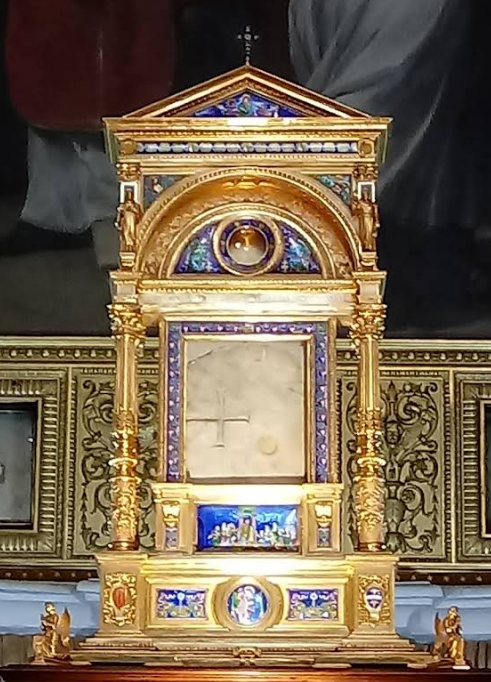
Pope Urban IV, who was residing in nearby Orvieto, immediately sent the bishop to verify the event and had the blood-stained corporal brought to him. On 11 August 1264, with the bull Transiturus de hoc mundo, he instituted the solemnity of Corpus Christi, extending the feast of the Body of the Lord to the whole Church. To house the relic, Orvieto built its splendid cathedral, where the Holy Corporal is still kept today in the Chapel of the Corporal.
What is Venerated in Bolsena Today
In the Basilica of Santa Cristina the faithful venerate the sacred stones stained with the blood of the miracle and the altar of the prodigy, enclosed within the evocative Chapel of the Miracle. The basilica complex — with the grotto of Saint Christina, the early Christian catacombs and the Renaissance façade — is one of the most important pilgrimage destinations in Lazio, a stop along the Via Francigena.
Historical Clues and “Adventurous” Research:
- The bull Transiturus: reading the text with which Urban IV instituted Corpus Christi reveals how deeply the miracle of Bolsena influenced the universal liturgy.
- The office of Saint Thomas Aquinas: it was Aquinas who composed for the new feast such texts as the Pange Lingua and the Tantum Ergo: a theological treasure born of this prodigy.
- Raphael’s “Mass at Bolsena”: in the Vatican Stanze, Raphael’s fresco immortalises the event: comparing the art with the chronicles is a fascinating journey.
Useful Information for Pilgrims
- Address: Piazza Santa Cristina, Bolsena (VT), Italy
- Opening Hours: check the Basilica of Santa Cristina website for times of visits, catacombs and celebrations.
- Getting There: Bolsena lies on the Via Cassia between Viterbo and Orvieto; ideally complete the pilgrimage with a visit to Orvieto Cathedral, home of the Holy Corporal.
Historical source: the international exhibition “The Eucharistic Miracles of the World” created by Carlo Acutis (miracolieucaristici.org).


Leave a Reply